Clearing a Sand Table: Our Spiral Sweep vs the Built-in R-L Wipe
One table, two ways to erase, and a test we almost got wrong
Key takeaways
- Drawing a new track straight over an old one left the old pattern visible wherever the new track did not reach, here the middle of the table.
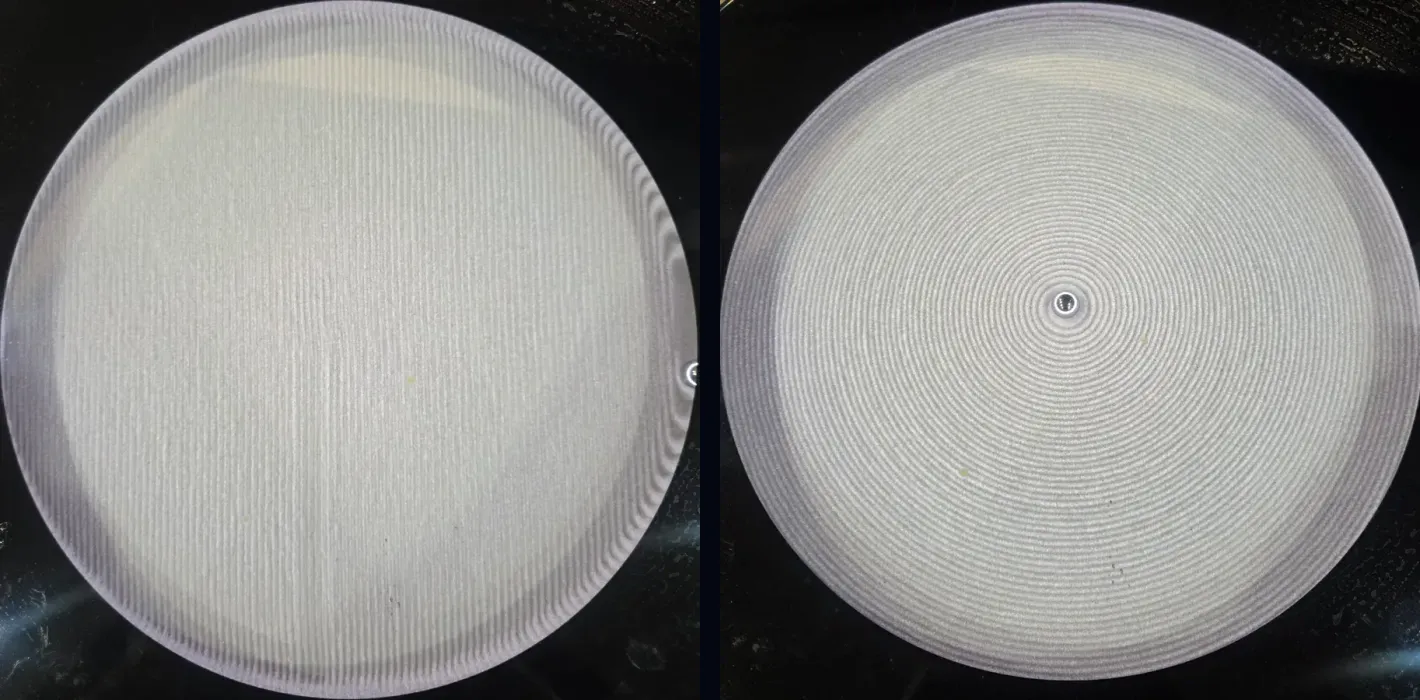
- The R-L wipe that came with our table cleared the whole surface into fine straight stripes, but left crescent-shaped ridges on the side where it finished.
- Our Clean Sweep spiral left even rings from the rim to the center. The center ring we saw on the first try was there only because we stopped the run early.
- With the table speed set to fast, the Sisyphus app showed 41:25 for the R-L wipe and 14:36 for Clean Sweep. Before a new pattern we now run Clean Sweep.
- This is one table and a few runs, judged by eye. Treat it as a starting point, not a rule.
By the CymaVis team · Updated
Why clear the sand at all
A sand table has one steel ball pulled by a magnet under the sand. It can only push sand aside, so every track is drawn on top of whatever the last track left behind. Where the new track passes, the old lines disappear. Where it does not pass, they stay.
We saw this with one of our new free tracks, Spirograph 8 : 3. We ran it straight after a 60-turn π curve without clearing the sand first. The outer star came out just as the Studio preview showed it, but this track never visits the middle of the table, and the middle still held the loops of the π curve.
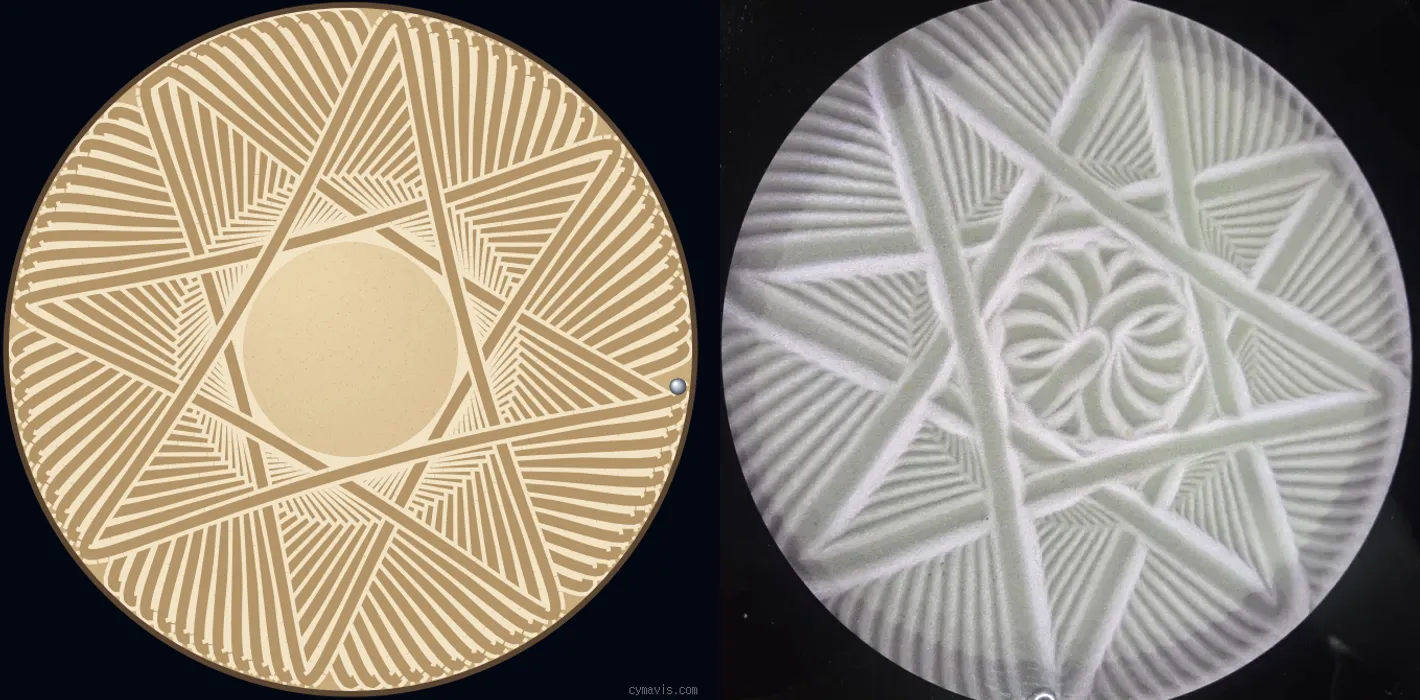
The Studio estimated about 19 minutes for this track, and the Sisyphus app showed 21:31. So for a track like this one, the estimate was in the right range.
So we wanted a reliable way to start from clean sand. Our table came with a clearing track called R-L wipe, and our free track set has a spiral called Clean Sweep. We ran both. CymaVis is not affiliated with Sisyphus Industries; we name the table only because it is the one we own.
The built-in R-L wipe
The R-L wipe moves the ball back and forth in straight passes, stepping a little each time, from one side of the table to the other. Halfway through you can see exactly how it works: one side is already fine stripes, the other still holds the old pattern.
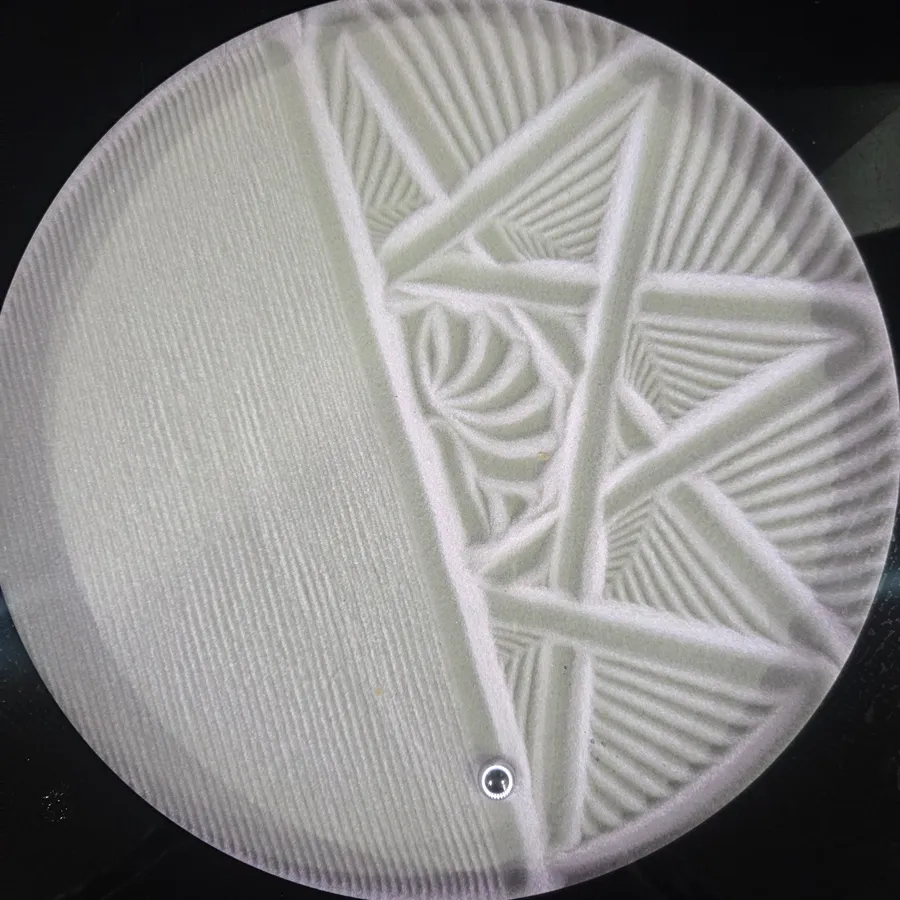
When it finished, the whole table was covered in fine, even stripes and the middle was clean. The weak spot was the side where it finished. There the ball turns around more and more often as the passes get shorter near the rim, and each turn left a crescent-shaped ridge.
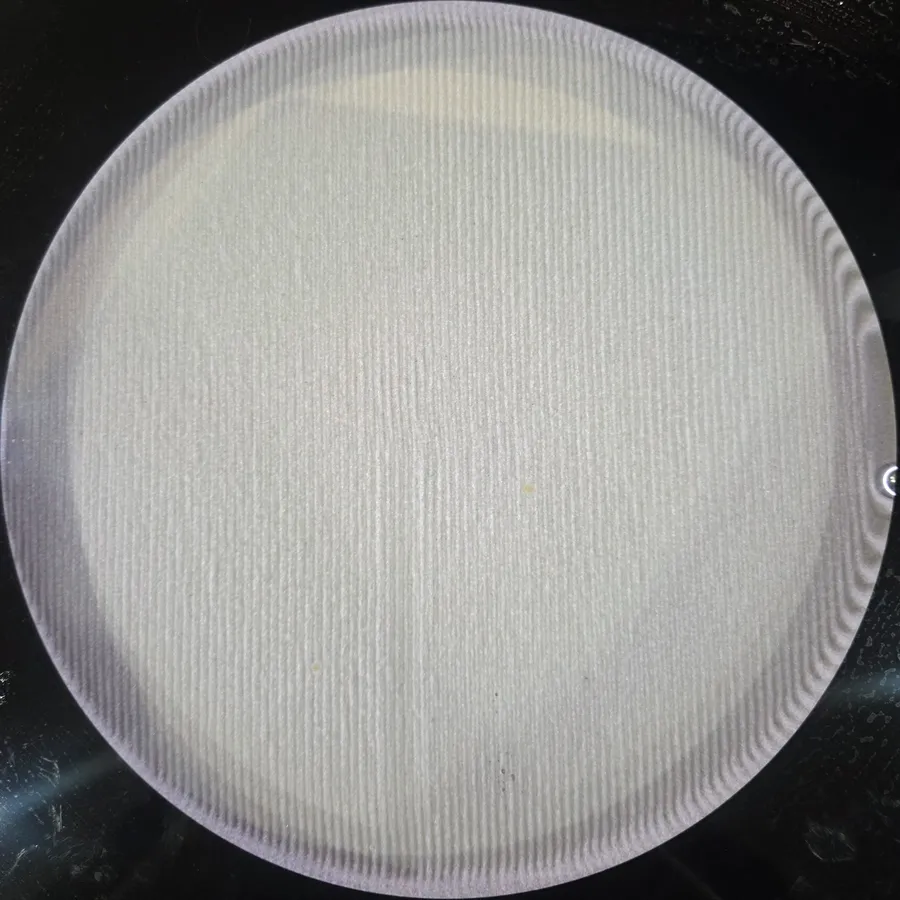
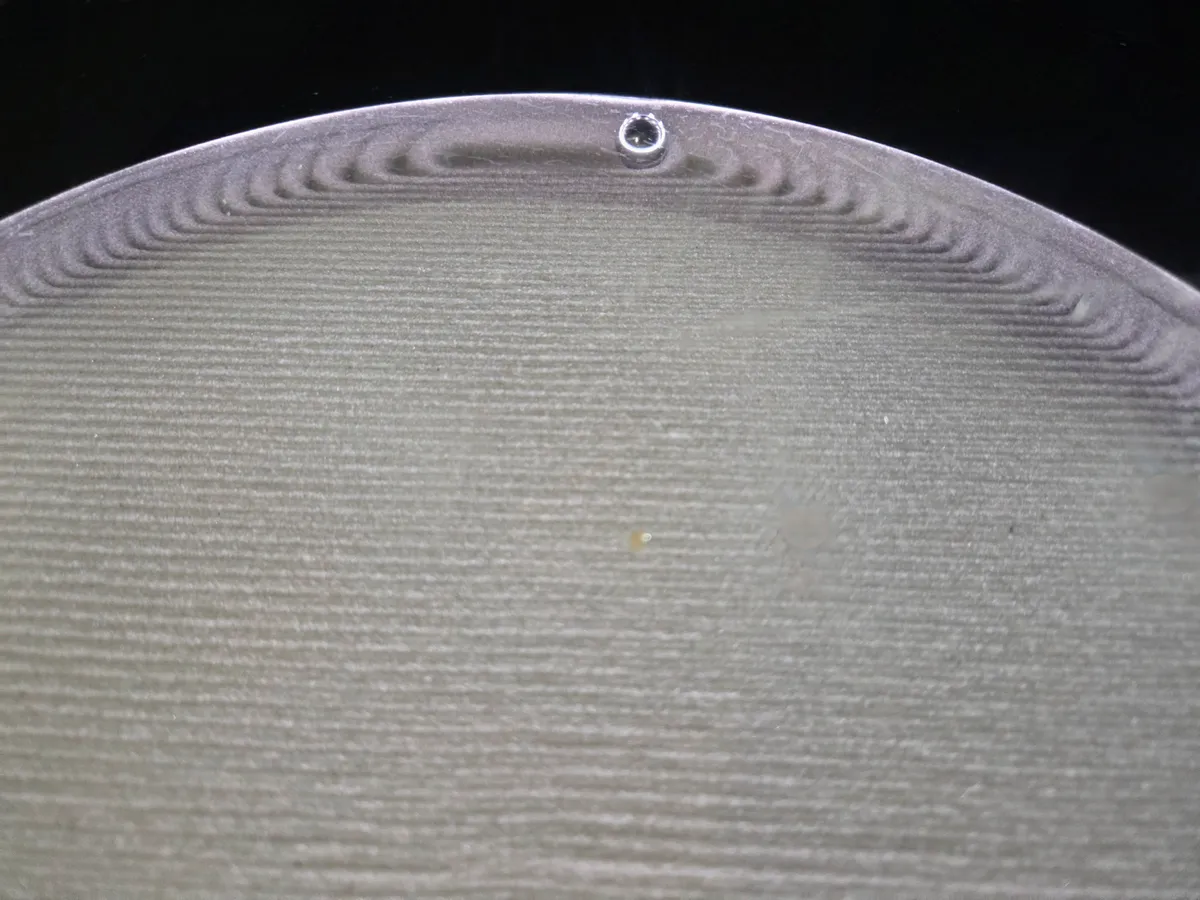
The name says R-L, right to left. In our photos the ball finished on the right, but we took them from the opposite side of the table, so from the table's own point of view that is probably the left. What we can say for sure is what we saw: the side where the ball ends is the side with ripples left over. It is not bad enough to stop us using it.
Our Clean Sweep spiral, and the test we almost got wrong
Clean Sweep is a plain spiral from the rim to the center in 60 tight rings. It is one of the ready-made tracks, free to download.
Our first run looked like a failure. The rings were even almost everywhere, but a small ring sat in the middle with the R-L wipe's old stripes still inside it. We started working on a second version that would finish the middle with straight passes.
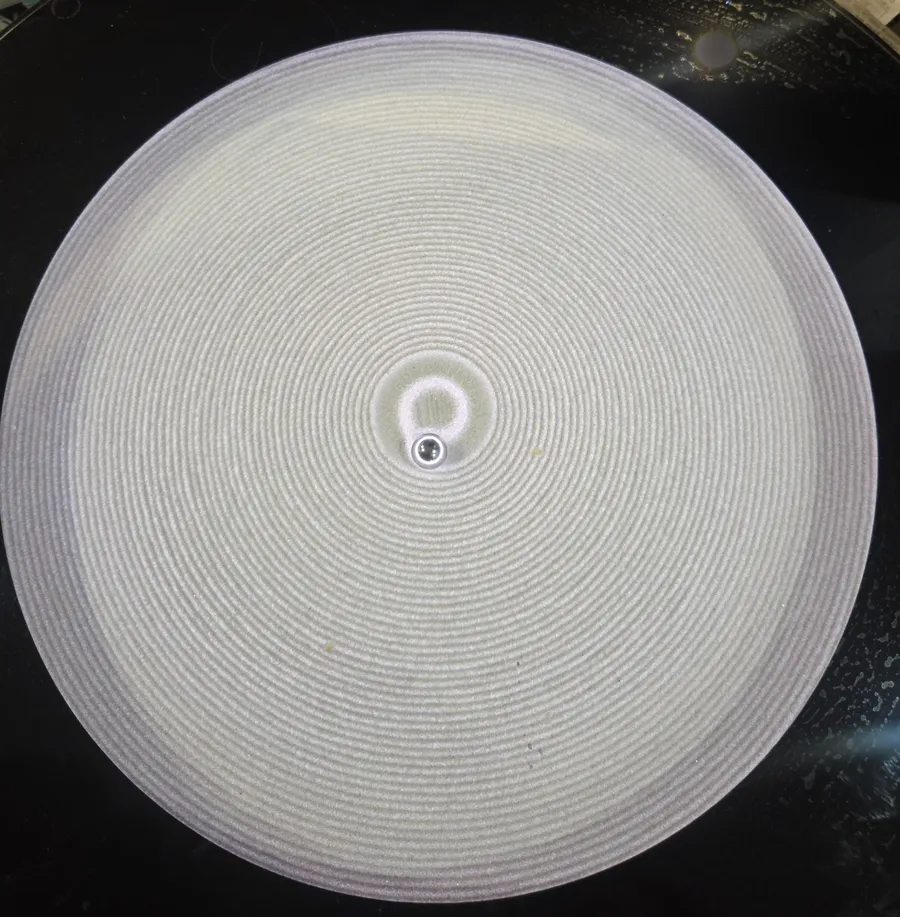
Then we noticed that the run had not finished. We had stopped it before the last few rings. When we let it run to the end, the middle came out clean, with only a small dent where the ball came to rest. We dropped the second version.
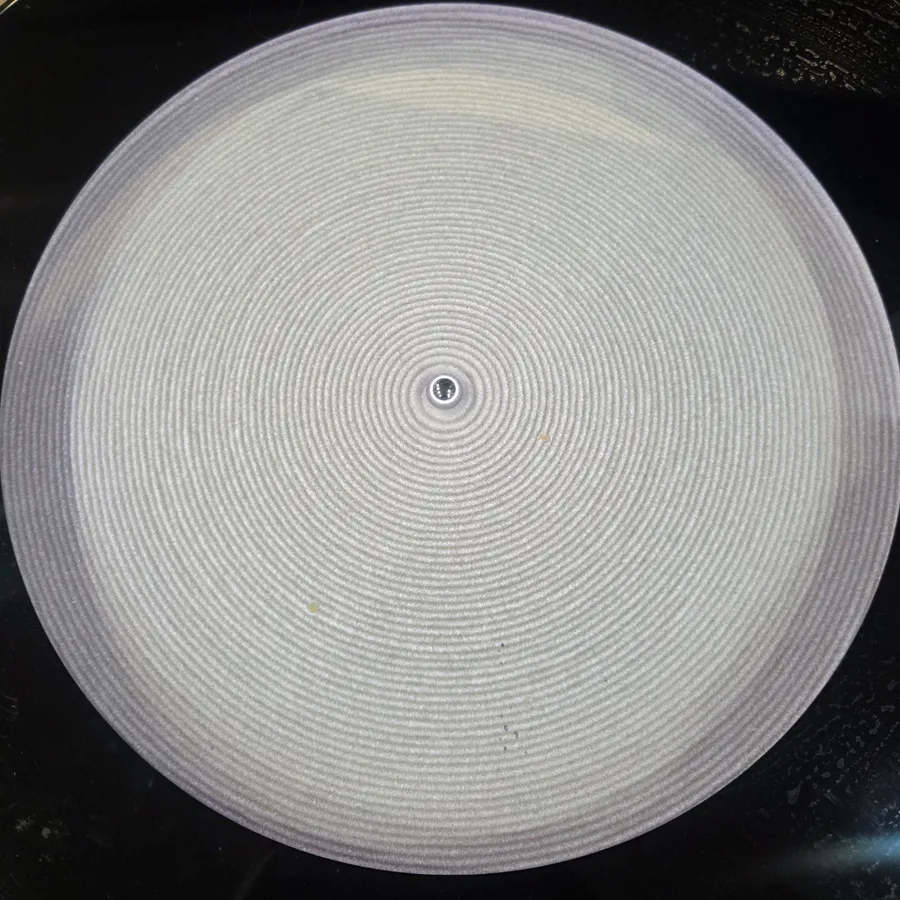
If a clearing track leaves something behind, first check that it really ran to the end. Ours looked broken only because we stopped it a few rings early.
Side by side
| R-L wipe (came with the table) | Clean Sweep (CymaVis) | |
|---|---|---|
| Texture left behind | Fine straight stripes | Even concentric rings |
| Middle | Clean | Clean, small dent where the ball rests |
| Rim | Crescent ridges on the finishing side | Even |
| Ball ends at | The rim | The center |
| Time shown in the Sisyphus app* | 41:25 | 14:36 |
| CymaVis estimate | — | about 20 min |
*We ran both with the speed slider set to fast. At that setting the real run felt much shorter than the time the app showed, maybe under half, but we did not time it with a clock. So compare the two app times with each other rather than with your own watch.
For us the result is clear enough: Clean Sweep leaves a more even surface and, in the app's own numbers, takes about a third of the time. When we want to start a new pattern quickly, we will run Clean Sweep first. The R-L wipe is still a fine choice if you like the look of straight stripes or want the ball to end at the rim.
Can a ball make sand flat?
Watching the two tracks made us think about what "clearing" really means. A ball cannot smooth sand the way a rake or a hand does. It rolls through and pushes sand to both sides, leaving a groove with a low ridge on each side. So a cleared table is never flat. It is covered in grooves packed so close that they read as an even texture.
That view explains most of what we saw, though these are our explanations, not measurements:
- Overlap decides how even it looks. On our table the ball is roughly 7% of the radius across, while Clean Sweep's rings are 1/60 of the radius (about 1.7%) apart. Each pass overlaps the last few, so the ridges stay small and regular.
- Turning points leave marks. Every time a back-and-forth wipe turns around, the ball piles a little sand into a curve. Near the rim the passes are short and the turns are packed together, so the curves show as crescents. A spiral never turns around, so it does not leave them.
- What the last pass does stays. Each pass erases what was under it. A clearing track is judged by how its final passes lie, which is also why stopping early made our spiral look unfinished.
- The resting point always shows. Both tracks leave a small mark where the ball stops: at the rim for the wipe, at the center for the spiral. Tracks that start where the last one ended avoid dragging a line across clean sand.
What this test does not prove
- One table, a few runs. Other tables, sand, balls and speed settings may give different results.
- Judged by eye. We compared photos and did not measure the height of the ridges.
- The times are app times. We ran at the fast setting and did not time the runs ourselves.
- Lighting changes the look. Low side light makes ridges stand out; light from above hides them. Our photos were taken under similar light, but not identical.
How we clear our table now
- Download Clean Sweep from the ready-made tracks and upload it to your table.
- Run it before any track that leaves part of the table untouched, such as Spirograph 8 : 3 with its empty middle.
- Let it run to the very end. The last rings are the ones that clear the middle.
- Start the next track from the center, where Clean Sweep leaves the ball, so the first move does not cut across the clean sand.
Frequently asked questions
How do I erase the pattern on a sand table?
Run a clearing track that covers the whole surface, such as a tight spiral or a back-and-forth wipe. On our table a 60-ring spiral (Clean Sweep) left the most even surface.
Why does an old pattern still show under a new track?
The ball only changes the sand where it passes. If the new track leaves part of the table untouched, the old lines stay there. Clearing the sand first fixes it.
Is the R-L wipe or a spiral better?
In our test the spiral left even rings with a clean rim, while the R-L wipe left fine stripes and crescent ridges on the side where it finished. Both are usable; the spiral was also faster in the app's time.
Is Clean Sweep free?
Yes. It is one of the free ready-made .thr tracks on the Sand Table Studio page.